
"Clean" and "natural" perfume claims, explained
These words appear on many perfume boxes. Here is what they officially mean, which is less than most people expect.
Disclosure: We may earn a commission if you buy through links on this page. It does not change what we recommend. Affiliate Disclosure
They have no official definition
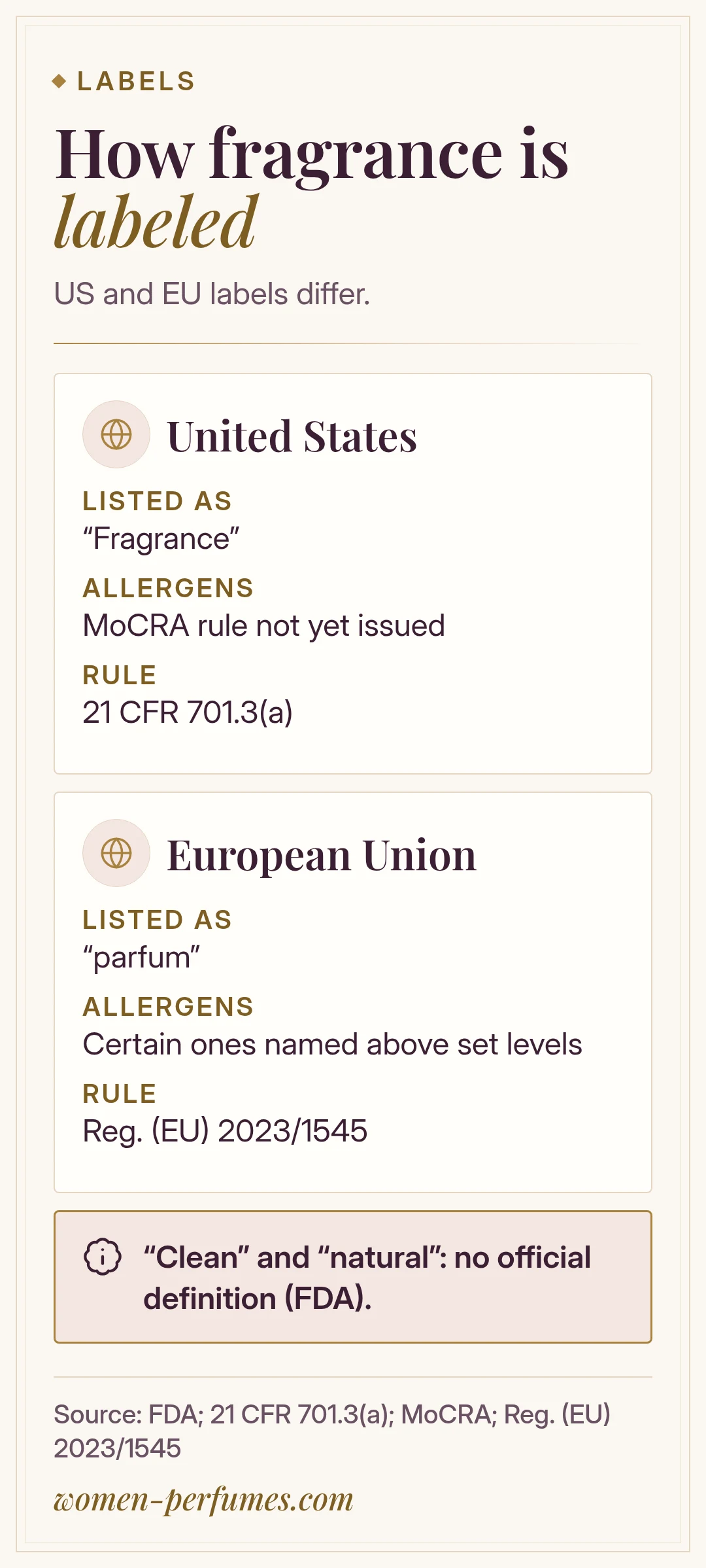
In the US, the FDA has not defined the term "natural" for cosmetics, and there is no regulatory definition of "clean" either. Brands decide what they mean by these words. Labels must still be truthful and not misleading, but the terms themselves set no standard.
What brands may mean
When a brand uses "clean" or "natural", it may be describing its own ingredient list, a list of materials it chooses not to use, or how it sources materials. These definitions differ from brand to brand. The only way to know what a particular brand means is to read the brand's own information. You can then say, "The brand describes this as [claim]," and judge for yourself.
Plant-derived and lab-made materials
Perfumes can use plant-derived materials, lab-made materials, or both. Both kinds are chemicals; everything is. Whether a material comes from a plant or a lab does not, by itself, tell you how your skin will respond to it.
How fragrance appears on US labels
Under US rules, the fragrance blend can be listed simply as "Fragrance". The individual materials inside it do not have to be named. A 2022 law (MoCRA) directs the FDA to require labeling of fragrance allergens, but that rule has not yet been issued.
How fragrance appears on EU labels
In the EU, the blend is listed as "parfum". Certain fragrance allergens must also be named on the label above set levels. An update to EU rules expanded that list for products placed on the market from 31 July 2026.
If you know you react to a fragrance ingredient, check the ingredient list on the label. In the EU, certain fragrance allergens must be declared on the label above set levels. Many brands also follow IFRA standards; check the brand's own information.
Questions worth asking a brand
- What does this word mean for your products?
- Which materials do you choose not to use?
- Do you list fragrance ingredients individually?
- Do you follow IFRA standards?
FAQ
Related guides
General information, not medical advice. Patch test new fragrances and stop use if irritation occurs. See a doctor about skin reactions or breathing concerns.
Sensitive to fragrance?
Practical steps, without the guesswork.
